Fiona Citkin

  • Home
  • Author
    • Bio
    • Story
    • Album
  • Books
    • Terminology and Translation
    • Transformational Diversity
    • How They Made It in America
  • Readers
    • FAQ
    • Contests
  • Blog
  • Guest
  • Advice on Reaching Success in the US
    • How to become an American Achiever
    • Resources for aspiring achievers
    • Your questions answered
  • Speaking
    • Topics
    • Talk-shows, interviews and media coverage
    • Who to contact
  • Events
  • Contact
  • Bookstore
    • Transformational Diversity
    • Achievers
    • Autographed copies for gift-giving

Death by Boycott? Why Brand Maker Turned Peacemaker

October 24, 2019

Intolerance Goes Viral, Sadly

The tendency to disregard tolerance as a cultural crown jewel of American culture is disturbing, especially because the US is a society of societies, of different ethnicities, religions, races, etc.—with tolerance being the most essential value of government by representation. Today, however, when certain individuals at the top of the country are fanning the flames of viral intolerance exploiting the sensitive topics to fire their bases, what can we expect of the rank-and-file? Led by example, as well as tweets, they throw the scruples aside and take no prisoners when something goes against their grain, be it the minor cases of the media personalities who leaned left-or-right and used the wording not to their liking – or the bigger topics of anti-immigrant, anti-Muslim, and anti-establishment attitudes.

Is political rudeness the only alternative to the brought-to-the-extreme political correctness? It looks like being politically correct has gone with the wind, and political weather forecast points to more viral intolerance—while we as society seem not to care. Or do we?


Brand Creator Speaks Out

A savvy PR professional, Dan Granger speaks out on tendencies in brand-making.

In a conversation with Dan Granger, CEO of Oxford Road, the ad agency that launched Hulu, Lyft, and Dollar Shave Club, I heard his heart-felt arguments about sponsorship that does not equal support; about the need for companies to show leadership and loyalty because only then they will stand out in the crowd; about our politically-charged environment and divisions in our culture hurting not only customers and sponsors alike, but also the public psyche. He is genuinely worried about the fast-spreading flu of boycotts that go viral in social media where the masses let hysteria take the wheel—which results in people joining in just for the sake of joining in. This is a dangerous phenomenon on all accounts, and Granger, a knowledgeable public relations professional, indicated the cases in point:

  1. The Case of Soul Cycle

In August of 2019, it was reported that billionaire Stephen Ross, the chairman of The Related Companies, which owns Equinox and SoulCycle, came under fire for plans to host a high-dollar Trump fundraiser.  Of course, people didn’t want even part of their money to be paid to political campaigning, so this caused a big uproar on social media and caused many people to boycott the high-end gyms.  Many people who work for the gyms were also offended that their company would be associated with the Trump campaign. In the end, the event did happen, and people did give up their memberships.  The real impact of events like this is a big splash on social media – and subsequently in the mainstream media – and then everyone moves on to the next “outrage” of the day. The practical result of events like this should be a law prohibiting companies contribute to politicians—which is kind of an advance bribery.

  1. The Case of Chick-fil-A

For the last few years, Chik-fil-A has seen itself embroiled into numerous different protests, from gay rights activists to transgender and LGBT allies, Chik-fil-A first came under fire in 2012, when the CEO admitted to donation to various groups that either downplayed or even rallied against, gay and other LGBT-related rights. Understandably, “Cancel Chik-fil-A” found its way into everyone’s twitter feed, Facebook walls, and Instagram captions. Chik-fil-A would go on to endure lots of protests that continue into 2019; ultimately, though, the momentum is nowhere on the level it used to be. Chik-Fil-A has slightly changed their tune – but their fast-food outfit has been not welcomed in the UK because of LGBT protests and at some University campuses. While they still have firm beliefs rooted in traditional Christian values, Chik-fil-A has started to fund more mutually accepting campaigns, like young persons’ athletics and education (although some, like the Christian Youth League, while not ostensibly against gay or transgender persons, doesn’t exactly like them either). Either way, just like SoulCycle, Bayer, or Nike, these are mostly short-lived protests in the hype of the moment, which die down when the next big thing takes its place.

  1. The Case of “Got Weed?”

The boycott hype is certainly real today. Sometimes, in fact, it is so real that people end up boycotting companies that don’t even have anything to do with the issue. Take for example the story of Randy Fox, the owner of Integrity Car Care. Randy’s auto shop saw lots of cars in and out of it, and everything was fine until Bud Commander, a cannabis shop in a completely different town, put up a billboard stating, “Got Weed?”. Next, Randy received a letter, petitioning to boycott his car shop, because of the billboard. An evident mistake! What ensued was residents calling for closing of the shop, and to take their cars anywhere but there – leaving Randy confused, as the billboard had nothing to do with his business; it was erratic and ridiculous to accuse him. We need to keep in mind that although it is important to work with others toward a cause that is important for us, the boycott culture has now gotten so extreme that a mere mention of something is enough to set it off – without any research or investigating. So, we need to be careful and do research before joining in, not to add to unreasonable hysteria.


Are Boycotts Any Good?

These three are great examples of how the tools of social and mass media are being used, and how hysteria can provoke you when you are faced with values against your own. And the answer to a question “Are boycotts any good?” is a resounding NO: all boycotts die of natural causes, after showing their futility or ridiculousness or both.

Indeed, do some people join in boycotting just to join? Probably. Do some people eat at Chik-Fil-A and still care about gay and transgender rights? Absolutely. Did every single person at SoulCycle vote for Trump? Of course not. And did all the past customers who trusted Randy with their transmissions return? Hopefully. These are all examples of the boycotts that take place with businesses, and the “lasting” impact they may have. Boycotts with a goal of hurting sales or otherwise derailing a company, rarely work. So, there’s no “death by boycott”, as some might hope. Boycotts aimed at canceling certain brands need to be strategic and calculated, not erratic or, God forbid, mass tweeted. Twitter’s 140 characters are enough to insult somebody or provoke you into a boycott to vent your feelings—but not to have a reasonable conversation to reach anything worthwhile.

Yes, I mean it: social media, invented as a means of uniting people with meaningful conversations, is increasingly turning into the means of disinformation and expression of intolerance if not outright hatred. But there’s no going back—so, let’s make the best of it. Remember: we, the people, need to understand how to separate politics from brands and personal beliefs from brands; also, keep in mind that brands are run by people just like us, those who have opinions just like they do.


#AmericansForTolerance

Even though intolerance today cannot be stopped in the tracks, it’s possible to use a vaccine against it—like we use the flu shots: no guarantee but we sleep better with it. There are different parts to this vaccine.

  • Dan Granger feels the need to be a peacemaker in this boycott-prone environment and calls for companies who are being protested not to cave to the naysayers and, in turn, show a message of strength and unity in turbulent times. A man of ideas, he is worth following.
  • There is an expressed need for companies and customers to come together—even if they disagree politically. To this end, I’d like to start a movement #AmericansForTolerance. Why? Boycotts and such proved to be ineffective destroyers of other-minded people or their companies; they are but different diversions of our attention and resources. According to Granger, “The peaceful exchange of opinions enriches everybody and isolates nobody.” As a professional educator and diversiculturalist, I stand with Dan Granger on his message of peaceful coexistence and hope you join us too. So, let’s take care of our own sanity and do research before joining the causes, for the sake of being consistent as well as strategic—and this will vaccinate us against mass tweeted intolerances.

Filed Under: Uncategorized Tagged With: #AmericansForTolerance, boycotts, brandmaker, Chick-fil-A, Dan Granger, Soul Cycle

Ukraine Makes the Headlines, Again! And Again, for the Wrong Reasons

October 21, 2019

Proud of the New Ukraine

Kiev, the capital of Ukraine, is beautiful in all seasons.

I periodically become a target of all-around questioning, just because originally—25 years ago—I came to the US from Ukraine as a Fulbright Scholar in cross-cultural and language studies. Of course, this gives me the leverage to deeper understand what’s going on there, and why. But I do not hold a magic ball that predicts what the future holds in this largely unpredictable country – and even more unpredictable America under the current government. So, let me just answer some of these questions and clarify my positioning.

When people get my new book about immigrant women, “How They Made It in America,” many shrug shoulders reading the explanation of the reasons for my emigration—and for leaving the high position in academia—which were rooted in snowballing corruption that I could not stand anymore. Yes, may be many countries have their own bureaucracy and corruption, but Ukraine is something special. And therefore, I am triple proud that in the recent elections 73% of voices went to the new President Volodymyr Zelensky, a Russian speaker from the Eastern region – and a Jew. This ran counter to the typical populist Ukrainian tendencies and showed that people were fed up with the old way of life.

May be, this time around the social-economic situation was so bad that the people overwhelmingly voted for somebody who gave the most hope to uplift Ukraine from the hole the former management put it into. And President Zelensky, however young and inexperienced, makes big strides to fulfil his promises, and—most importantly—pull his country out of a deadlock war with Russia. To reach this goal, he needs money, weapons and support of the United States. But will he do a “small favor” to the almighty American President who held this money, although approved by the Congress? This episode featuring Ukraine made headlines all over the world. I am no judge of what the Presidents should or should not do. A good question is whether Zelensky has a choice. As for the rest, I can only provide my consulting opinion.


Past Predicts Future

When thinking of Ukraine, consider the following:

  • For over twenty-five years of my life in the United States, whenever I answered “Ukraine” when asked where I came from, I’d hear, “Ah, Russia!” Home to 42 million people, Ukraine was little-known — until bloodshed in Kiev’s Maidan Square and continuing mayhem provoked by Putinesque instigators brought it into headlines. The media, however, often understated the situation, thus hurting American understanding of this strategically important European country.
  • Critically, Ukraine, the second-largest military state in Europe (after Russia), surrendered its nuclear warheads in 1994, after the U.S., UK, and Russia had guaranteed the integrity of its borders. Now, when Ukraine sees the army of Russian President Vladimir Putin at the gates and is torn apart by pro-Russian separatists, Ukrainians feel betrayed by the all former guarantors. And it looks like nobody cares.
  • The late U.S. Sen. John McCain, speaking on Late Night with Seth Meyers, dismissed Russia as a “gas station run by a mafia masquerading as a country.” I never agreed with that. Russia may be a mafia, but with many nuclear warheads! Their warheads can annihilate the world three times over. And by now, maybe four times.
  • And this mafia stops at nothing, as its track record in Chechnya, Georgia and Crimea had proven. It’s not to be downplayed! Unfortunately, many politicians in America and Europe alike appear unaware of Putin’s goal, which was applauded in the Russian Duma: to reconstruct the U.S.S.R., in a smaller but stronger version — including Ukraine. That statement from the past predicts the future.


Historical Roots of the Russian-Ukrainian Conflict

  • Despite their territories changing hands and enjoying only a short-lived independence, most population of Ukraine identifies as Ukrainian, whether or not their mother tongue is Ukrainian or Russian (which is often the case in Eastern Ukraine, where I have been born). Language issues notwithstanding, the growth of national consciousness began with the struggle of the independent Ukrainian People’s Republic from 1917 to 1921. Soviet Premier Joseph Stalin drowned it in blood, adding the man-made Famine-Genocide of 1932-33, the deportations of the so-called kulaks (rich farmers who opposed collectivization, and one of my granddads fell victim to it), the physical annihilation of the nationally conscious intelligentsia, and general terror to subdue the nation.
  • The people of the Ukraine are fighting a vicious battle against organized crime, corruption and the forces of evil. While we shook the Soviet yoke in 1991, many of the corrupt, communist apparatchiks unfortunately managed to hold onto their positions. The crime and corruption continued but the Ukrainian people have finally had enough and are bravely making their stand.
  • The condescending and dictatorial “big brother” habitually ridiculed Ukrainian nationalism (equating it to narrow-mindedness) and even the traditional love of borsch; everything Ukrainian was regarded as second-tier, inferior to everything Russian. Facing repressions, Ukrainians kept a low profile.
  • But no low profile anymore! Multiple sources inside the country report a sharp rise in Ukrainian national consciousness, and even people who used to be indifferent to the issue favor Ukrainian unity over Russian recolonization. This chronicle makes Putin’s takeover of Ukraine — and the ensuing, never-ending chaos and civil war — problematic.


Ukrainian Americans Provide Insights on Ukrainian Culture

As a believer in culture’s power to condition and predict our success, I think that in order to grow U.S. influence in this strategic geopolitical region, we need to better understand the mindset of its people — because the culture prophecy is as steady as it gets in our ever-changing world. In 2016 there was a sizeable number of 347,759 Ukraine-born Americans. Among celebrities who contributed big time to the US well-being and culture, the first names that spring to mind are from Hollywood: Ukraine-born actresses Mila Kunis and Milla Jovovich – as well as Dustin Hoffman and Steven Spielberg who are proud of their Ukrainian heritage.

Let’s look at two other successful Ukrainian-Americans for insights into the Ukrainian character, culture, and contributions.

Oksana Baiul: Queen of the Ice

  • Oksana Baiul, a retired Ukrainian figure skater, emigrated from Ukraine to America after becoming the 1993 World Championship Gold Medalist and the 1994 Olympic Gold Medalist in Ladies Figure Skating. Orphaned early, Oksana lived in Odessa with the wife of her coach, demonstrating talent and true grit on her way to becoming the queen of the ice. Her relaunched career in America went well; for example, she collaborated with renowned ballet dancer Saule Rachmedova to bring together the Ice Theatre of New York and had many public appearances, including on MTV’s Total Request Live.
  • A passionate person, Oksana never forgot her roots: She supports the Tikva Children’s Home, which aids the Jewish children of Odessa.
  • Oksana has been living in the U.S. for years, but her national consciousness is strong and prompts her to voice her support for the good of her former compatriots. She feels their pain at the Maidan events and beyond.

Helen Schneider, Ph.D.: Happy Health Economist

  • Helen came to the U.S. to study economics, knowing that America had given the world most of its Nobel Prize-winning economists. She proved to be flexible, moving from Kent, Ohio, to study at Agnes Scott College in Atlanta, then to Cornell University in Ithaca, New York, then to the University of California, Berkeley, for her post-doctorate, then to work at the Los Alamos lab in New Mexico, and finally – to the University of Texas in Austin, with its outstanding Economics Department.
  • Helen embraced the diversity of America’s regional cultures, thus becoming an all-American girl. Her integration into each place was heartfelt: her family still remembers how her immersion in Southern culture expressed itself as “Yankees are no good! Well, some may be…” Today Helen is an all-inclusive Texan — because everything is bigger and better in Texas. She’s passionate about teaching health economics and econometrics, the tough subjects, plus some of her articles made headlines in top professional journals and brought her awards. Her cultural sensitivity helps in teaching a diverse student population at UT, and she’s happy to do what she loves.
  • Helen stays in touch with her old friends in Ukraine and Russia and remains poised and graceful, never taking sides when Russia-vs.-Ukraine opinions become polarized or even hostile, but she believes Ukraine deserves to be independent, not subservient to Russia, because of the specific culture.


Democracy Is Difficult to Dose and Dispense from the Outside

The flexibility, talent, passion, and national consciousness of these and many other Ukrainian Americans reflect the history-and-culture prophecies of their country of origin. Today’s Ukraine, a struggling nation, made the headlines again, and not in a favorable context. But America should not jump the gun and withdraw support; Americans can extend support differently, while never underestimating Putin’s track record and Russia’s warheads.

Besides, in any country, democracy and a sense of fairness are difficult to judge, dose or dispense from the outside, especially when one knows as little of the country’s history and culture as our typical politicians seem to. Let’s make a better effort—and we’ll continue to have Ukraine as a strategic partner in a geopolitical European region!

Filed Under: Uncategorized Tagged With: America, Helen Schneider, Oksana Baiul, past predicts future, President Zelensky, Russian warheads, Russian-Ukrainian conflict, talented Ukrainian-Americans, Ukraine, Ukrainiam culture

English with an Accent and Roots of the New Intolerance

August 28, 2019

Who Radicalizes Them?

On a fine Sunday morning I got upset beyond repair. It was at a Starbucks parking lot that I accidentally touched the next car when opening my car’s door; got out and checked: no scratch, thank goodness. At this point, the car’s driver screamed, “You scratched my car!” “Sorry but it’s not a scratch, just dirt,” I said. She came around, touched it, felt no-scratch-just-dirt, and blurted out, “I don’t want to deal with you anyway: you speak with an accent, and you immigrants do more damage than simple scratch.” And she left.

She left me feeling pissed off. It was a clear case of “oppressive language,” of which Toni Morrison said that it “does more than represent violence; it is violence.”

Nobody ever said such a thing to my face in my 25 years in America. Why now? As one journalist remarked when interviewing me about my new book, “Before, anti-immigrant folks kept their opinions to themselves. But not any longer: now they get instigated from the top.”

This is the pro-diversity, pro-women, and pro-immigrants book.

Indeed, today all right-wingers feel free to denounce immigrants out loud at their rallies where they enjoy radicalizing each other. In fact, I should be happy that woman did not shoot me, as some anti-immigrant individual did at El Paso, TX shooting, expressing the blind rage against everything that seemed foreign. People like him are not exactly crazy, just effectively radicalized to believe they are entitled to judge who is worthy to live and who is not. Radicalization spills into violence, and everybody knows who the chief instigator is.

No Need to Take It Personally?

Now, how to oppose – or mitigate – this intolerance which is increasingly crippling our great nation? Let’s start from a smaller issue, the accent intolerance. I know I shouldn’t take it personally. A linguist by education, I know about the research proving that after puberty a new language acquisition typically comes with an accent. But most people are unaware of that—and in a big picture of the radicalized mob’s attitudes, immigrants with accents are to blame for all their bad luck, financial and other.

There is more to it than meets the eye. As shown in Rosina Lippe-Green’s book, English with an Accent, accents support social structures od inequality, where employers discriminate on the basis of accent, and the judicial system protects the status quo and reinforces language subordination. This book calls for a serious discussion of American attitudes toward language—and this is why. A language-culture ceiling does exist, invisible but palpable: about 66,6 million (20 percent) of Americans who speak a language other than English at home, may face linguistic discrimination, if they work outside of high-tech. They often start their own companies out of necessity—and doing so they add thousands of jobs, upping America’s well-being. And when the country flourishes economy-wise – who cares to take bigots personally?

What’s at the Root?

Tolerance is not about left or right, liberal or conservative politics. It’s more. It’s about the roots of intolerances-gone-wild that everybody needs to recognize. Educating the masses about them is key, and here is the essence.

We know that people who speak different languages perceive the world differently — with different cultures influencing styles of decision-making and communication, ways of presenting our thoughts, different meanings for talk and silence — even different values. Nonverbal behaviors, such as expressions of respect, understanding and strong emotions can be badly misinterpreted. At the root of human behavior, culture is king, it trumps language and accent.

This means we need to include culture studies in the whole host of immigrant issues. Most importantly, we need to include this in the immigration reform discourse — and legislation. Politicians and media, however, typically focus on the immigration reform legalities, totally ignoring the critical issues of linguistic and cultural integration—a big mistake which adds to growing misunderstanding and negativity towards immigrants!

So, it is not enough to speak English without an accent. Always consider the root of the issue, culture.

What’s to Be Done? Be Bold, Accent or No Accent

Incidentally, I interviewed and featured 18 prominent American immigrant women in my book, How They Made It in America, all of them the speaking with some accent. Let’s look at Ivana and see her way of addressing the accent intolerance.

Ivana Trump, from Czechoslovakia, set her own standard for linguistic integration. She was born to be bold: her beauty, athletic prowess, fashion style, and street smarts often made the news. Ivana made her initial fortune the old-fashioned way, marrying a millionaire and assuming a major role in the Trump organization. There, she acquired enough business savvy to start successful companies of her own.

This is Ivana Trump before emigrating from Czechoslovakia: she has always been confident and in a winning mood which helped her American integration.

What we need to remember is that her bold self-confidence prevailed over limited English proficiency: “If you don’t really understand — smile a lot. Makes you look wise and happy,” shared Ivana. It took more than smiling to master her English — which shows in her cameo role in a Hollywood movie, The First Wives Club, and in four books (including Raising Trump). Her thick accent aside, Ivana’s had a bold ability to adapt culturally, which is key.

And it seems to me—although I didn’t interview her yet—that Melania Trump, from Slovenia, also adapted smiling attitudes with beautiful bold style, and I never heard anyone being condescending of her because of her accent. Wait for her memoirs to come out!

Out with Intolerances!

Generally speaking, condescending attitudes toward immigrants are “older than America itself.” Some intolerant folks habitually downgrade the contributions of 40 million foreign-born working Americans.

We cannot afford these intolerances much longer: global realities push us to hold on to all available resources, including the creativity of our immigrants. Sustaining a climate where they feel desirable and productive means acting for the sake of America’s prosperity — so, out with intolerances!


Top of Form

Please like this post – and share your thinking.Bottom of Form

Filed Under: Uncategorized Tagged With: anti-immigrant rallies radicalize participants, English with an accent, new intolerance, roots of intolerance, taking intolerance personally

#AmericansForTolerance

July 21, 2019

Populism Persists – America Perishes

It is utterly upsetting me to uncover the ugly side of today’s reality: the fact that many people fall for the divisive rhetoric of the right-wing media and presidential campaign. The North Carolina crowd chanting “Send her back” referring to an immigrant Congresswoman Ilhan Omar made my hair stand on end, vividly reminding of the old Nazi videos, all hateful and racist. The slogans that propelled Hitler to power were “Germany above all!” and “Germany for the Germans” – and a few years later the Jews, Gypsies, gays, and the critics of ruler all marched to the gas chambers. Let’s keep it in mind.

It isn’t that I take this chanting too personally: I am not a woman of color, or Muslim, or of Somalian descent, or a “left-wing extremist.” No way. But the quote from Martin Niemoller, an anti-fascist German pastor, stands bright in my mind:


“First they came for the Jews and I did not speak out because I was not a Jew.
Then they came for the Communists and I did not speak out because I was not a Communist.
Then they came for the trade unionists and I did not speak out because I was not a trade unionist.
Then they came for me and there was no one left to speak out for me.”


This broadly means that each of us, Americans, needs to stand up for those publicly hounded and humiliated, i.e., for the American values of freedom, fairness, and equality. The quote is also a warning about the dangers of compliance with the Divide and Conquer policy of maintaining control over one’s subordinates/electorate by pitting one group against the other, thereby preventing them from uniting in opposition. A winning formula of all populists and dictators in the world, Divide and Conquer is now enacted in the United States. I know it but too well because this is exactly what President Putin of Russia is now successfully implementing in my native Ukraine.

One of the currently hounded women is an immigrant, three others belong to minorities—but as sure as the day is bright, the list will build up swiftly because the intolerance disease is highly contagious.

It looks like not too many people are willing to speak in defense of the four attacked and demised Congresswomen. The Democratic politicians voted to condemn Trump’s “racist comments”, of course, but the GOP – by staying silent – are largely accepting this hatefulness—although some pundits say that they “panic about the ‘send her back’ chant,” but not too much. Well, there is nothing new about this situation: the lack of integrity and decency, the willingness to dismiss today the very idea they were advocating for yesterday, from the top of their lungs, is what makes up a typical politician: from the right, from the left, from anywhere. But we, the people, are not politicians, aren’t we? We care about our country and the values of freedom and equality that we’ve been brought up with. As far as I see it, if we allow such kind of populism persist, America-as-we-know-it perishes.

I do not share the views of the four Reps of the “squad,” moreover, I believe they are wrong on quite a few issues. However, the very idea of someone being hounded/demised for speaking up her/his mind sounds very troublesome to me.


We need to stand up and speak up for those harassed and hounded. Or else.


Speaking Up for Inclusiveness and Tolerance

A former Fulbright Scholar who authored “How They Made It in America” book earlier this year, I met critical acclaim at Voice America, Straight Talk Show, and some other outstanding media and newspaper interviews. They appreciated the fact that for this book, I researched and interviewed over 100 prominent women immigrants who “made it,” including some celebrities, like Isabel Allende, Alfa Demmellash, Josie Natori, Ivana Trump, etc., painting a picture of successful women who became Americans by choice. The success stories and strategies of eighteen profiled immigrant women of the first generation reveal their significant contributions to America’s well-being and culture – as well as their deep integration into the all-American cultural values. They became the role models for immigrants and native-born alike.

An immigrant myself, I felt that writing about prominent immigrant women to elevate this whole subset of contributing Americans is my thing and my duty. Why? Because I understand them in-depth; because we are social twins wearing different cultural make-ups but possessing one common denominator – the need to integrate and prove our worth. And now I am their voice too, especially of those not yet in the celebrity ranks. I am willing to speak up for them, for including them, and for raising tolerance level towards them. I know these women richly deserve it.

Incidentally, the fact that President Trump harasses immigrants while having married two women immigrants (Ivana Trump, his first wife, has been profiled in my book) speaks volumes of his essence.

In fact, my major motivation for writing How They Made It in America was to help educate the masses who sometimes fall too easily to the anti-immigrant catchphrases. You can learn more about myself and the book in the brief video: https://www.youtube.com/watch?v=RJJRETOoBEk

As you will see in the book, the interviews with the book subjects illuminated their American Dreams, their values, what they love in America – and why – and what they advise to other women who seek success in the US. Another thing you will be able to learn from the book is how overwhelmingly all immigrant women appreciate and love America, consider it their true home, feel gratitude to the American people who accepted and helped them on the way. Their talents are serving America 100% of the time. And we need more talented individuals like them to arrive, we are all richer for that. Please, read the book and share it with those you love!


Hot-Hot Topics 

Immigration and women are the hottest topics of today’s discourse, in both politics-oriented and private conversations. They are becoming hotter and hotter, and there’s nothing wrong about it, provided we keep our cool and display more Tolerance for the opinions that differ from our own.

Indeed, if I could start a movement, I’d love it to be an inclusive-leadership-oriented #AmericansForTolerance. Why?

Tolerance is a great but neglected value, although it’s one of the pillars for the American democracy. There is visible deficit of Tolerance in our country and beyond, and as a result, democracies are starting to limp. Clearly, our media is not doing its job with respect to Tolerance as an integral part of democracy. For certain politicians Tolerance became a no-no option, they rather prefer to fly high on more profitable divisiveness. Let’s realize it—and move on, starting #AmericansForTolerance movement, now!

The Point of #AmericansForTolerance

We badly need to deal with the hot topics of immigration and women in more effective and civilized ways. How? We need to school people in Tolerance, roll-out multi-level Tolerance education country-wide—as prevention of hate crimes, mass shootings, prejudice against different cultures and/or opinions, and such. It is a good question whether we need to tolerate intolerance Let’s think about it. Meanwhile, I hope that How They Made It in America – describing immigrant women’s great contributions to the United States – will encourage greater Tolerance, inclusivity, and unity of our diverse nation.


Filed Under: Uncategorized Tagged With: ', #AmericansForTolerance, American values, chanting "Send her back, How They Made It in America book by Fiona Citkin, immigrant women

How to Write and Publish a Book about Immigrant Women

March 22, 2019

Inspiration Notes

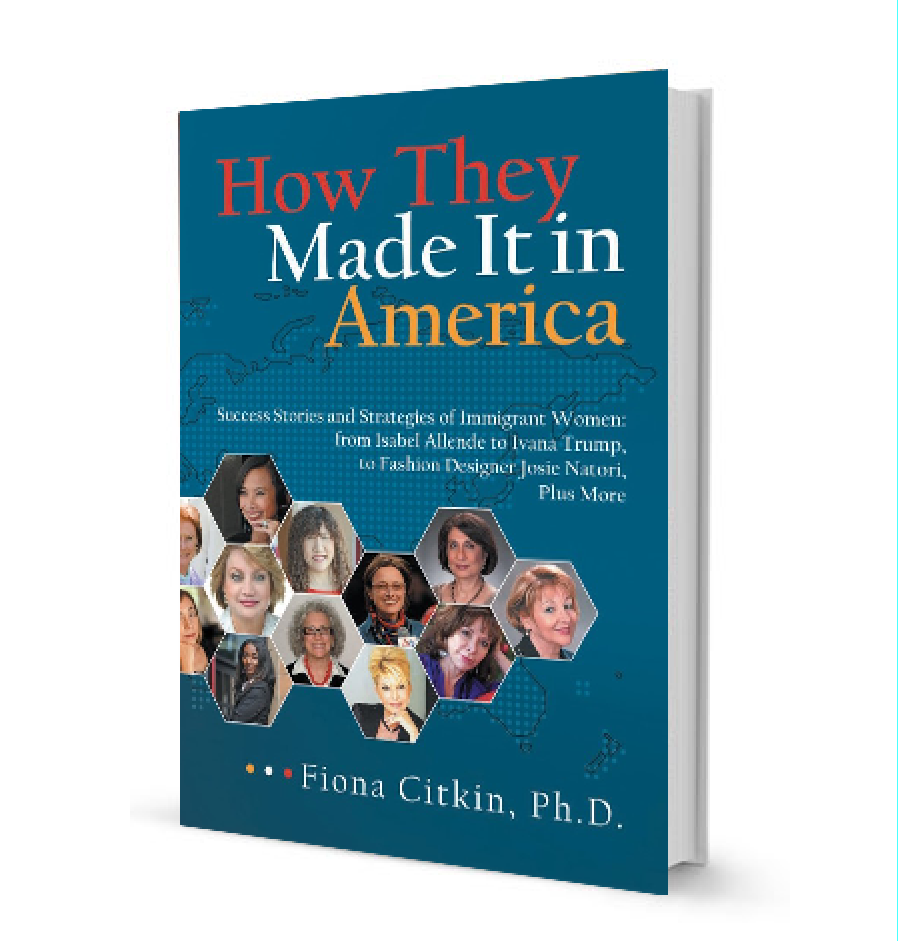
A Ukrainian-American and immigrant myself, I got an idea to uncover a shortcut to success for all immigrants and other beginners by learning about top immigrant women’s experiences: what they did and how they did it to succeed in presumably the most competitive country in the world. The endeavor started out as an intercultural research project featuring prominent immigrant women adapting to America. Here’s a picture of all of them profiled in my new book.


The hard cover of “How They Made It in America,” 2019, picturing 18 book subjects plus an author

The approach to focus on top immigrant women is fresh enough, I thought, to be perceived positively by the public. After all, the everyday life and misery of less fortunate immigrant women has been sufficiently described to give us a big picture of the costs for becoming a new American – for example, in a book Immigration and Women: Understanding the American Experience.  Research also suggested that immigrant women are the most oppressed demographic worldwide, especially in the Muslim countries. And instinctive fairness triggered my interest.

These considerations prompted a concept of the new book: if the toughest cases of American immigrant success-under-stress worked out wonderfully, we need to know what enabled them, so we too could crack the all-American success code.

While interviewing my book subjects, I couldn’t help thinking that, had I met them earlier in my career, I might have been able to devise a shortcut to my own success. It is now my hope that by drawing attention to the lives of these extraordinary achievers, scores of other women—native-born as well as immigrants—will benefit from their accumulated wisdom as presented in the book.

Digging further into the topic, I understood that “immigrant women” is not just a hot topic but a cause worth fighting for, so I picked it up—and it became my major inspiration. You can get the others in my answers to the most frequent Q & A.


Personal Questions to Author

After authoring – and publishing – three books, I realized that people and media alike are more interested in my personality than in the content of my books. Is it because all my books are non-fiction? May be. Let’s see some repeated personal questions regarding “How They Made It in America” fresh-out-of-print book:

  1. What inspired and motivated you to write this book?

I typically give one of the three answers to this question, as follows.

First, I am inspired by strong women, inside and outside my family. I’ve always been fascinated by the “fair sex,” not the “weaker sex.” And I learned that successful fair sex are the women who are happy. Other women’s unhappiness stems mostly from their jammed potential, because realizing one’s potential is more tangible and fulfilling than a fleeting orgasm: it stays with you. And this understanding motivated me to do something to help more women be happy—by providing them with a blueprint to replicate the success of the best women role models.

Second, I was motivated by the challenge to fill the gap in the field social studies.

My book subjects belong to a special subset of the American women who had never before been viewed as a group—and it turned out to be the kind of challenge that the academic in me got attracted to like a butterfly to fire.

Third, I was inspired by analyzing and describing my own kind. As a first-generation immigrant, I belong with my book subjects, we’re social twins, albeit fraternal, not identical, wearing different cultural make-ups but possessing one clear common denominator – the need to integrate into the all-American culture, and prove our worth on the new turf, whatever it takes.

  1. Was there anything unexpected that you personally learned from your interviews?

Yes. One thing was Hilda Ochoa-Brillembourg’s answer to my “American Success Scale” (which is a 1-to-10 score self-estimate of personal achievement: where do you stand on the American success ladder today?). Hilda, a top achiever in the finance business, estimated her success at Score 9, commenting, “Ultimate success at Score 10 is achievable but not sustainable.” I remembered that—and when one of the three women who said they did reach Score 10, got fired from the top position in her own company, Marvell, this wise remark from Hilda came to mind, Score 10, an ultimate, global success point, is achievable but not sustainable. We all need even more humility, that’s my unexpected lesson.

The Taming-of-the-Shrew Process

“The Taming of the Shrew” is a play by Shakespeare published in 1898; I enjoyed it as an English major at the University—and during my book research, I began associating this phrase with the daunting process of getting through the ranks of multiple gate-keepers/assistants of the prominent immigrant women I planned to interview. The gate-keepers have their own wild ways to always say No, thus they had to be “tamed.” It took a lot of my time and energy to persuade every gate-keeper, or the “shrew,” to forward my request for an interview, as they typically brushed me off, either instantly or after dragging their feet for a while, hoping I’d get tired first.

But I persisted, as persistence is my second nature. Honestly, that “taming” was the hardest part of my book writing process because all other hurdles paled in comparison. Unfortunately, unlike Shakespeare’s Petruchio, I couldn’t keep the shrew gate-keepers hungry ? and had to apply a velvet-glove handling.

Truth be told, whenever luck did put me in direct contact with the top immigrant women-achievers, each of them said Yes to the process: to initial interview, to filling out extensive 18-page Questionnaire (I admit to being out of my mind making it so long), to follow-ups, to proofing their Profiles, and such. It was indeed time-consuming! But my book subjects are the women with big hearts, the most generous souls I had ever met in America, all willing to go through the process, inspired by the goal to help “those who will come after us.”


Ideas Along the Way

After conceiving the book idea and commencing research, I was becoming increasingly excited by my subjects, who kept surprising me with their revelations—and our interactions led me to develop ideas, later published in my Huffington Post blogs, articles, and my own website http://fionacitkin.com/ ; here are some of them:

  • Special immigrant creativity

Writing about women who dared to go reinvent selves in a new country with amazing creativity prompted my interest to why some people are more creative than the others. Sure enough, I discovered for myself a special psychological research into the creativity issues and built on that, elaborating it all in The Business Case for Immigrant Creativity.

It appears that the native creativity in each of my book subjects was enhanced by their immigration experiences: the intensity of living in two worlds, as difficult as that is, brought about a two-dimensional perspective that led to new ideas and created new businesses.

  • Special immigrant-women demographic

Empowered with my in-depth perspective on immigrant lives, I deliberated on what I called the “Diversity Shield” as a way of referring to “affirmative action” – first used in Executive Order signed by President John F. Kennedy on 6 March 1961. This led to developing a 5-point business case for immigrant women as distinct diversity demographic.

My study shows that all parties of this special demographic are subject to ‘quadruple jeopardy’ [FC]; not even Ivana Trump who became a citizen marrying the rich man was exempt. Like every other immigrant woman, Ivana faced challenges of the new culture, language, glass ceiling which discounts women’s personal input, more responsibilities for bringing up children, and such. Becoming rich by marriage does not solve all problems automatically, so nobody is exempt.

  • Special input of immigrant women to America’s well-being and culture

Fifty blogs summarized the special input of American immigrant women into America’s well-being and culture – and then distilled the collective know-how of my interviewees in multiple how-to case studies under Seven Success Values part of the book.

As one of the early reviewers, Craig Storti, noted, “You’ll probably pick this book up for the 18 women whose stories it tells—and these are some very impressive individuals. But there’s every chance you’ll stay on for the advice that Citkin distils from the profiles. Self-help has seldom been made so interesting.”

  • Special resilience of immigrant women

Long before the book came out, surviving a quadruple jeopardy and winning the odds has been amply described in my blogs—starting with Guess Who’s Coming to Dinner: What Do Immigrant Women Bring to the Table? to Immigrants’ Integration and American Women Role Models. Simply put, the profiled women succeeded in America under exceptionally difficult experiences, and they have much to teach us about cracking the American success code.

As distinct as each of them is from the others, all book subjects have demonstrated intelligence, grit, drive, compassion, and leadership skills—although their lives are not the beds of roses. The U.S. may be a country of opportunity, but as HOW THEY MADE IT IN AMERICA makes clear, the best opportunities are reserved for the talented, the determined, and the prepared.


Publishing as Special Saga

How to publish a book about immigrant women is a very, very sensitive issue. On the one hand, women topics are in demand in the #MeToo era. Plus, the topic of immigration is quite in demand as well, considering the squabbles at the political arena. On the other hand, the “immigrant women” topic, bringing together two abovementioned focuses, was slipping between the cracks for a while, and I could not find an appropriate home for my book. Why?

Searching for a good literary agent has taken a lot of my energy and proved a total waste of time: the experienced agents liked the book’s concept and content but feared it won’t sell solidly, based on their prior experiences when women-and-immigration topics were not that popular.

At that point, I turned to publishers directly and found them more responsive: several professional editors gave me excellent advice of how to perfect and position the book. I took it, cut the number of the book subjects in two (as “readership does not need an encyclopedia about immigrants”), trimmed the content by one-third (as “today’s readers have a short attention span”), and sure enough, landed a big-name publisher all by myself.

My big catch was a progressive-minded Editor-in-Chief of “intelligent non-fiction” publisher who encouragingly wrote to me they need more books like mine, which have a distinctive topic, come in series – thus becoming ever-green, expand the readers’ horizons, and contribute to the idea of open borders (although I never had the latter in mind). Anyway, I considered his attention a huge honor: OMG, a publisher of such statue, and its Editor-in-Chief writing to me!

However, my joy was premature. Why? After several consecutive runs of improving the manuscript (changing the order of chapters; changing the title; replacing some central terminology and fine-tuning the content accordingly; uprooting the “authorial voice” pieces; trimming and condensing the content, etc.), the publisher’s Board turned the tables on their Editor-in-Chief who was pro-book – and gave me a pass. From start to finish, the submission process lasted nearly two years. What a mess! How did I feel as a result? Distressed I was. Deterred I wasn’t.


Remarkable Resilience Remaining Relevant

One of my favorite quotes from Winston Churchill is, “Success is never final; failure is never fatal; courage is what counts.” So I plucked up my courage and moved on, and in half a year landed another publisher because after all prior trials and tribulations with editing, the book became as flawless as could be. I got a beautiful book in the end. My research-and-writing topped with a lengthy submission process cost me a pretty penny—but I have no regrets. Why?

What matters is that my mission of giving the world a book about success stories, strategies, and remarkable resilience of prominent immigrant women has been fulfilled. Now all success-hopefuls can pick up the brains of the best American role models and use their know-how to go up in life. This remains relevant today as never before.


Final Thought

The first century scholar Hillel put it famously:

“If I am not for myself, who will be for me?

If I am not for others, what am I?

And if not now, when?”

Really, friends, let us stand up for ourselves, as immigrants or native-born, and let us also be there for others, to preserve our human dignity. And let us do it now and always. Amen!

Filed Under: Uncategorized Tagged With: immigrant women as special demographic, resilience of immigrant women, special immigrant creativity, special input of American immigrant women, Writing and publishing a book about women-immigrants

Press-Release: “How They Made It in America”

December 6, 2018